FPGA Packaging and Moisture Documentation: A Receiving Checklist
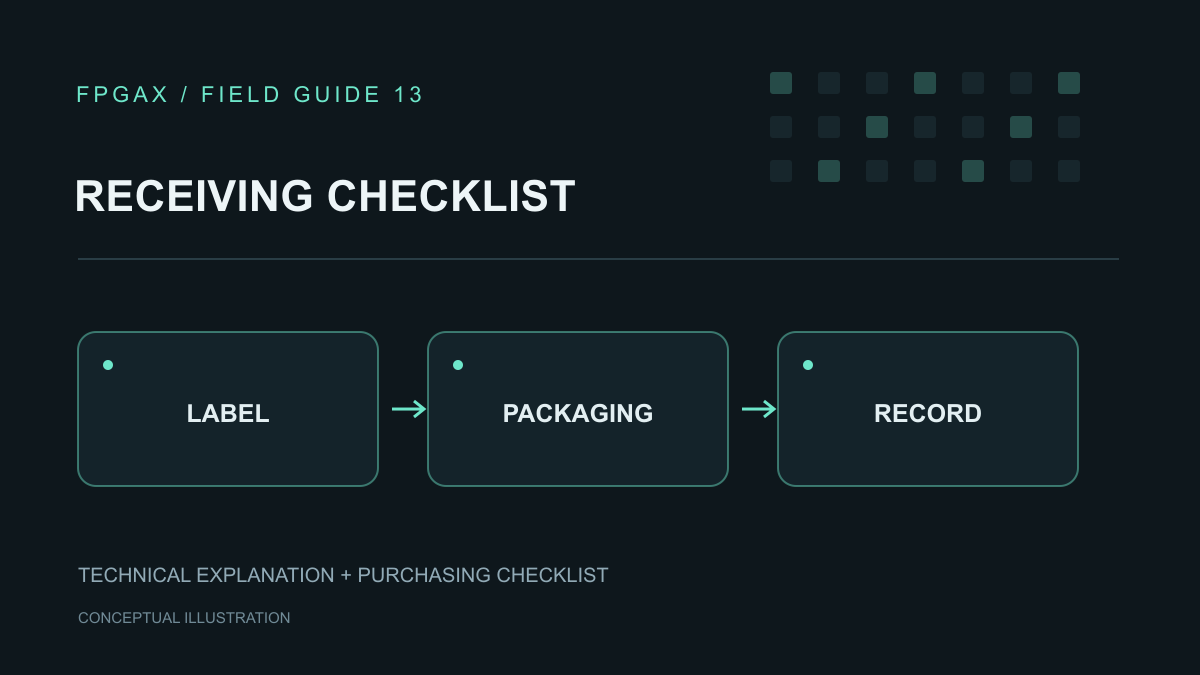
When FPGA components arrive, preserve the packaging information that the assembly team will need later. A receiving record should connect each container to its part number, quantity, moisture-handling information and any opening or repacking history supplied with it.
The goal is a documented handoff to the people responsible for storage and assembly. This checklist is an editorial workflow. Select handling conditions from the applicable manufacturer instructions and your approved process for the exact device and package.
Understand why the packaging record matters
Microsemi's Moisture Sensitivity note explains that absorbed moisture can damage plastic packages during soldering. Its handling guidance covers bag integrity, retaining the seal until use, and reading the humidity indicator immediately upon opening according to the card's instructions. Moisture Sensitivity, revision 5.0, printed page 3
For receiving staff, the practical task is to collect reliable observations and pass them on. Avoid selecting a corrective process from a generic internet table. A missing label, unknown exposure history or inconsistent record belongs on a question list for the responsible manufacturing or quality engineer.
Decide in advance who may open a container for inspection. Coordinate any internal inspection with the handling team, and record the reason for opening. That decision should be part of the receiving process.
Record the shipment before changing it
Give each received container a unique internal reference. Capture the supplier, purchase-order line, receipt date and quantity associated with that reference.
Photograph the exterior labels and any visible damage before relabelling or repacking. Keep the original image files. If a label is unreadable, retain the image and transcribe only the characters you can identify. Put interpretations and corrections in separate fields.
Compare the labelled part number with the purchase order. Record any mismatch without replacing the requested number. When one shipment contains several containers, give each a separate row so that a later question can be traced to the right material.
A shared shipment number can link those rows. It should not erase differences between their labels or handling records.
Distinguish dates that describe different events
Keep the device date code, bag-seal date, receipt date and opening date in separate columns. If a date's meaning is not stated, label it as unresolved.
Microsemi's historical AC441 storage note discusses bag-seal dates and humidity indicators as information relevant to stored plastic-packaged FPGAs. It should not be converted into a universal acceptance age for incoming goods. AC441, June 2015, printed page 3
For a repacked item, ask which date belongs to the latest packing event and how that event links to the original container. Preserve the earlier record where available. A new label should not silently replace an unknown part of the history.
If the seller cannot provide an event history, record that response. The receiving team should not invent an opening time to make the worksheet complete.
Use a receiving worksheet with clear ownership
The following fields form a proposed record. They are not a statement that every package carries every field.
| Record area | Information to capture | Who resolves a gap |
|---|---|---|
| Material identity | Requested code, labelled code and container reference | Purchasing with engineering |
| Quantity | Ordered, labelled and received quantities | Receiving and purchasing |
| Exterior condition | Observed condition and linked photographs | Quality reviewer |
| Moisture information | Labelled sensitivity level and applicable instructions | Manufacturing engineering |
| Packing history | Seal or repacking date and supporting record | Supplier contact and quality |
| Opening event | Time, operator, reason and container reference | Responsible handling team |
| Indicator observation | Card identification, observation and image if opened | Qualified handling reviewer |
| Storage transfer | Location, transfer time and responsible person | Stores or production |
| Disposition | Released, pending information or held for review | Authorized decision owner |
Keep observation and decision separate. “Label missing” describes an observation. “Release approved” is a decision that needs a named owner and a basis.
Make the handoff useful for assembly
The assembler should receive the exact device/package identity, the current container reference and the handling record that goes with it. Include links to the applicable manufacturer documents.
Ask the manufacturing engineer to resolve the permitted exposure conditions, the method for recording exposure and what action is required if the history is incomplete. Put the governing document and revision in the work instruction.
If material moves between stores, inspection and production, define who updates the record at each transfer. Use a consistent date-time format and time zone where multiple sites are involved. A later reviewer should be able to reconstruct the sequence without asking which clock a timestamp used.
For a partly used container, retain the connection between the remaining quantity and its existing history. Record the quantity issued and the quantity returned. Have the approved handling process govern any repacking or further treatment.
Escalate exceptions with specific questions
A useful exception report gives the container reference, observation, affected quantity and required decision. Attach the evidence already collected.
For example, a fictional receiving note might say: “Container R-02 has an unreadable seal-date label. Quantity shown is 24. Exterior photographs are attached. Packing history and handling disposition are pending review.” This states what is known without assigning an unsupported exposure time.
If an indicator observation is unclear, retain its printed instructions and ask the designated reviewer to interpret it. If corrective treatment is proposed, require an approved instruction that identifies the applicable device, carrier, process conditions and responsible operator. This article supplies no baking temperature, duration or universal floor-life allowance.
Close the record before material is issued
Check that each container has a disposition and that open questions have an owner. Confirm that the production issue record carries the correct quantity and history forward.
When requesting FPGA components from FPGAX, state which packaging and handling records your receiving team needs. Ask what information is available for the proposed shipment so your team can plan the review before arrival.