How to Read an FPGA Part Number: Package, Speed and Temperature Codes
Keep the complete manufacturer part number in an FPGA purchase request. Check the device, package, speed grade and temperature option separately, even when a proposed part looks almost identical to the approved bill of materials.
Start with the manufacturer's ordering information for the exact family. This guide uses a published AMD/Xilinx example, then gives a practical review checklist. The checklist is an editorial recommendation for purchasing and engineering teams; the linked manufacturer documents define the device specifications.
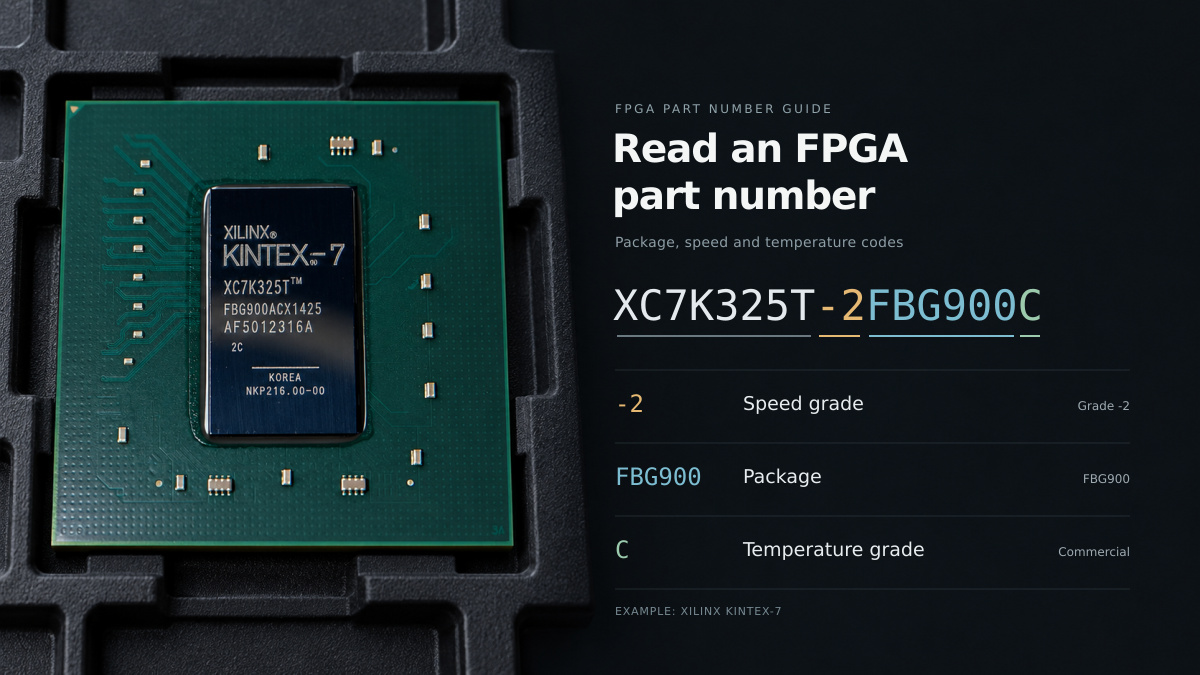
A verified example: XC7K325T-2FBG900C
AMD/Xilinx uses XC7K325T-2FBG900C in Figure 2, page 16, of 7 Series FPGAs Data Sheet: Overview, DS180 v2.6.1, dated September 8, 2020. Reading that diagram gives the following breakdown. Source: DS180 ordering information.
| Field | Meaning in this example | What to record |
|---|---|---|
XC7K325T |
Kintex-7 device identifier | Preserve the whole identifier |
-2 |
Speed grade | Keep the hyphen and grade together |
FB |
Package type code | Check the package drawing |
G |
Pb-free identifier in this package class | Check the applicable material documentation |
900 |
Package pin-count field | Verify the complete package and pinout |
C |
Commercial temperature option | Check its specified operating range |
Check that the proposed combination exists: DS180's ordering section warns that some devices may not be available in every listed speed and temperature grade. The example above explains the code; it does not establish present stock or delivery availability.
Package codes need a drawing and a pinout
For the example's FBG900 package, UG475 v1.20 identifies a flip-chip lidless BGA with a 31 × 31 mm body and 1.0 mm ball pitch. These details appear in Figure 4-30. Source: UG475 package specifications.
A purchasing review should carry the complete package code forward. Ask the hardware engineer to compare the manufacturer's drawing with the approved PCB footprint, then check the exact device/package pinout against the schematic.
Our recommended comparison should cover power and ground connections, I/O banks, configuration signals, clocks and any required transceiver connections. Record the engineer's conclusion against the two full part numbers. A comparison that says only “same package size” leaves the electrical review unanswered.
For an Artix-7 case focused on package-dependent connections, see XC7A35T CSG324 versus CSG325: pinout and PCIe.
Speed grade is a family-specific specification
For Kintex-7, DS182 v2.19 lists -3, -2, -1, -1L and -2L speed grades, with -3 offering the highest performance. Its introduction also describes voltage-dependent behavior for low-power variants. Source: DS182 introduction.
Read the whole grade, including letters. Avoid turning a grade into a single assumed clock frequency or removing a low-power suffix from a purchase request.
Before accepting a different grade, ask the design owner to review timing with the intended device settings. DS182 directs users to the static timing analyzer for more precise design timing data. Keep the resulting approval with the BOM change. This creates a traceable engineering decision when purchasing later encounters the same proposed substitution.
Temperature codes refer to defined operating conditions
For the Kintex-7 grades discussed here, DS182 Table 2 specifies these junction-temperature ranges:
| Temperature code | Range in DS182 |
|---|---|
C, commercial |
0°C to +85°C |
E, extended |
0°C to +100°C |
I, industrial |
−40°C to +100°C |
These are junction-temperature limits. Ambient air temperature is a separate input to thermal analysis. AMD's Xilinx Power Estimator guide explains that its junction-temperature estimate also depends on the device activity, board and cooling environment. Sources: DS182 recommended operating conditions, UG440 thermal model inputs.
For procurement, our recommendation is to copy the approved temperature code exactly. If someone proposes changing it, request an engineering assessment of the actual operating conditions. Record the assessed conditions alongside the decision so a later buyer can understand why the alternative was accepted.
Do not carry one family's decoder into another
Even within 7 series, DS180 provides separate ordering diagrams for Spartan-7 and for Artix-7, Kintex-7 and Virtex-7. Use the diagram that matches the device.
Another manufacturer's arrangement can differ further. Altera's Cyclone IV Device Handbook, March 2016, places operating temperature before speed grade in its ordering examples. It identifies 6 as the fastest listed grade and uses optional suffixes including N for lead-free packaging and ES for an engineering sample. Source: Cyclone IV overview, Figures 1–2 and 1–3.
Those examples explain why a universal “larger number means faster” rule would fail. For another family, start again with its ordering diagram and applicable data sheet.
A recommended checklist before sending an RFQ
Use this workflow to make the request easy to review:
- Copy the approved full part number. Take it from the controlled BOM or engineering record. If the record is incomplete, preserve the incomplete text and flag the gap.
- Record the manufacturer and family. Save the ordering-document title, revision and relevant page with the internal review.
- Separate the fields. List device, package, speed and temperature in individual columns beside the original code. This makes a one-character difference visible.
- Identify every proposed change. Put the requested and offered numbers on separate lines. Ask engineering to assess each changed field.
- Keep commercial details separate. State quantity and required date independently. Record supplier statements about availability as quotation information.
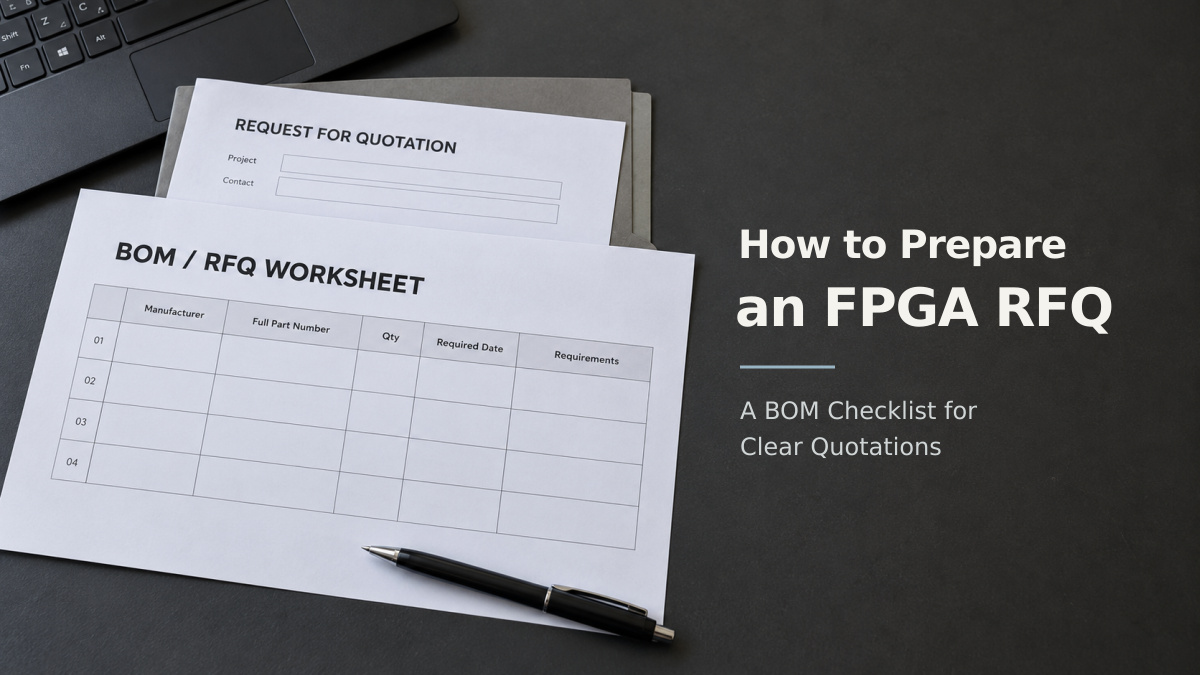
- Close unresolved questions explicitly. Use “pending confirmation” for an unreadable character or unknown suffix. Keep the RFQ marked for review until the full code is agreed.
To request a quotation, send FPGAX the exact manufacturer part number and required quantity. Include any unresolved suffix or proposed alternative as a separate note.