FPGA Date Codes and Traceability: What Evidence Can Establish
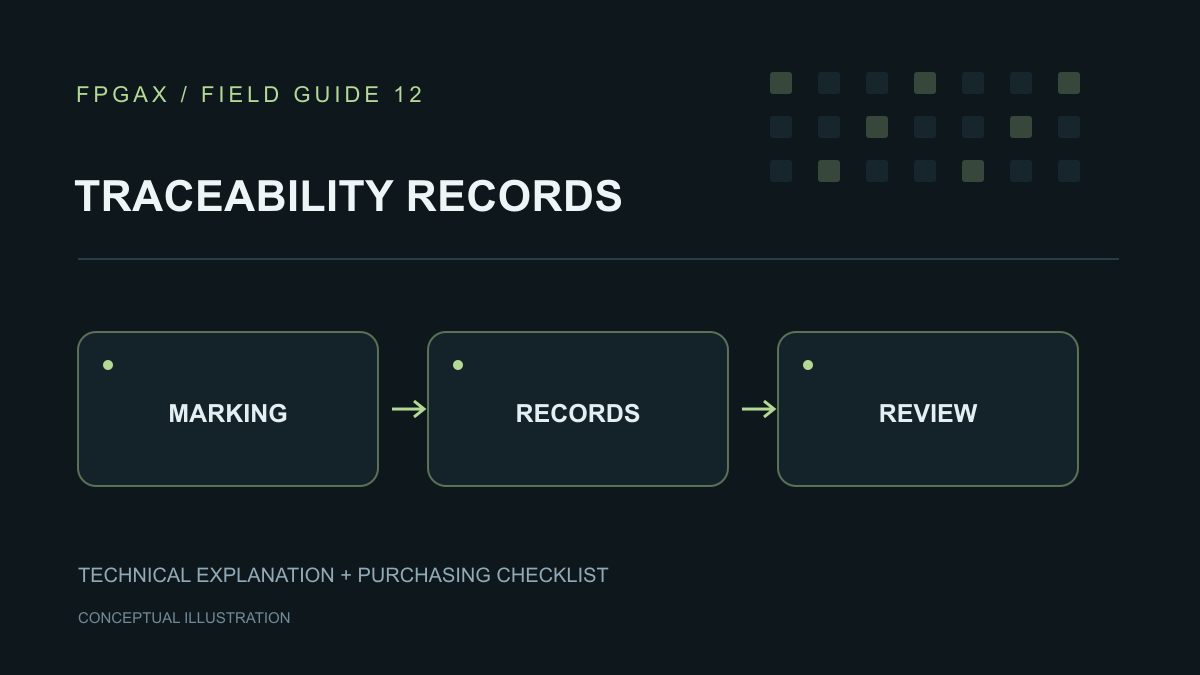
An FPGA date code is one field in an evidence record. To evaluate an offered lot, connect the exact ordering code, package markings, shipment labels and supply documents to the goods you will receive. Record what each item supports and what remains unverified.
This article describes a document-review workflow for buyers and quality teams. It does not authenticate a component or prescribe a laboratory test plan. Those decisions require the appropriate expertise and evidence for the particular lot.
Decode markings with the correct manufacturer reference
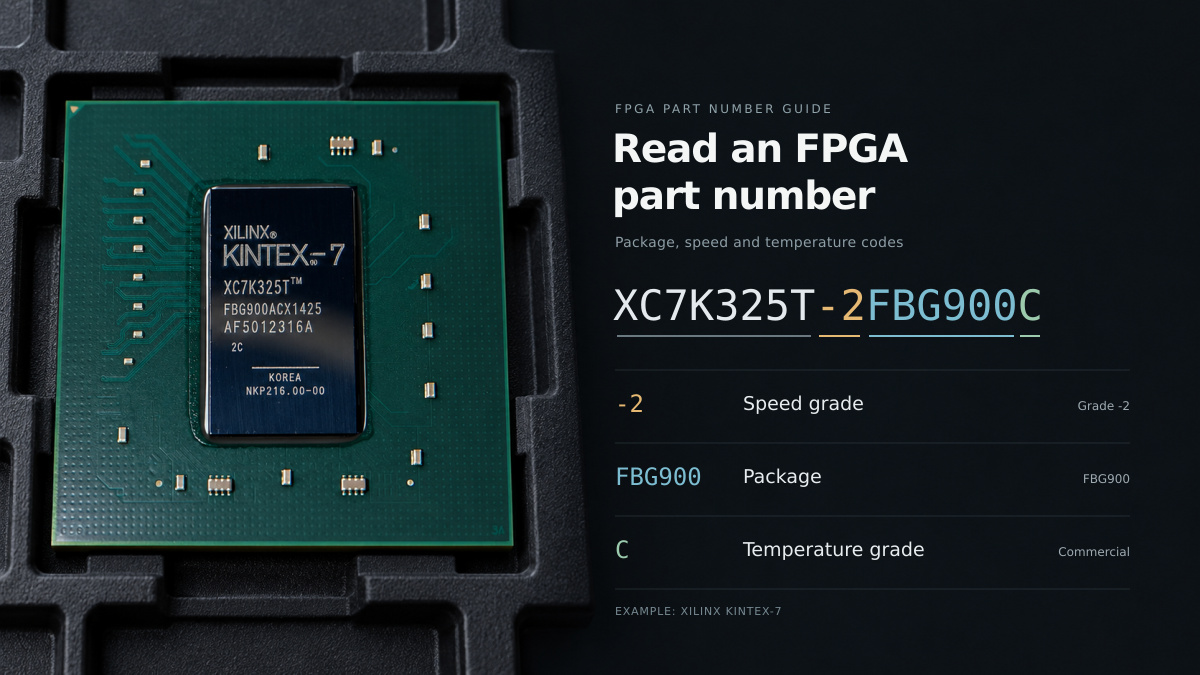
Begin with the manufacturer, device family and package. Preserve the photographed marking exactly as seen. Put any interpretation in a separate field, with a link to the reference used.
There is a concrete reason to avoid a universal date-code decoder. Intel's MAX 10 marking guide distinguishes date, lot and trace fields. Its six-week scheme maps YY07 to workweeks 7–12. Apply that scheme only to the documented packages. MAX 10 marking guide, pages 4–9
If a character is unclear, record the uncertainty. Ask for a clearer image or manufacturer clarification. Replacing a blurred character with the most plausible one would conceal the original evidence gap.
Keep the image filename, the item or container it depicts and the date it was obtained. Ask whether a quotation photo shows the actual offered lot or a representative example. Record the answer.
Separate four questions
Use distinct review fields for identity, source, condition and suitability.
Identity: Do the labels and markings describe the item ordered? A difference calls for an explanation tied to the manufacturer's marking convention.
Source: What documents connect this quantity to the seller and earlier supply stages? Record the issuer and the scope of every document supplied.
Condition: What information is available about packaging, handling and storage? Missing history should remain visible to the quality reviewer.
Suitability: Has the exact part been accepted for your design and purchasing requirements? A traceable lot can still be the wrong package or grade for the BOM.
This separation prevents a strong answer to one question from being copied into every status column. It also makes it easier to assign the unresolved question to the right person.
Ask for records tied to the offered quantity
Our recommended enquiry is specific: identify the offered manufacturer part number, quantity and available lot identifiers, then request the records supporting that offer.
Where goods have been divided or repackaged, ask how the resulting containers are linked to the earlier record. Request a clear mapping between the seller's internal lot reference and the identifiers on the material.
Avoid demanding information merely to make a file look complete. Agree which documents matter to the purchasing decision and when they must be available. Record any proposed redaction and assess whether the remaining information still supports the intended check.
For certificates or declarations, retain the document title, issuer, identifier and covered items. Ask what the issuer actually states. A seller-issued statement should remain labelled as such unless its claimed manufacturer origin has been verified.
A practical evidence map
The following table is our review aid, not a manufacturer authentication procedure.
| Evidence | What to check | Limit to record |
|---|---|---|
| Package photographs | Legible markings and connection to offered lot | An image alone does not establish authenticity |
| Outer and inner labels | Part, quantity and lot references agree | Agreement does not prove the full supply history |
| Purchase or shipment records | Issuer, dates, quantities and linked identifiers | A missing transfer remains a gap |
| Certificate or declaration | Issuer, exact scope and document identity | The title alone does not establish what was verified |
| Storage or repacking records | Material reference, event and responsible party | A record covers only the events it documents |
| Inspection report | Method, sample identity, findings and limitations | Results must be interpreted within their stated scope |
| Manufacturer response | Question asked, reference and exact response | Preserve any conditions or unresolved points |
Attach evidence to the relevant row instead of placing every file in an undifferentiated folder. A reviewer should be able to follow the link from a questioned identifier to the document intended to resolve it.
Treat date restrictions as a purchasing requirement
If your organization specifies a date-code range, state the rule precisely and identify who can approve an exception. Keep that requirement separate from a conclusion about the condition of a specific lot.
Microsemi's historical AC441 note highlights bag seal dates and humidity indicators when discussing stored plastic-packaged FPGAs. That discussion does not establish the condition of a particular offered lot. AC441, June 2015, page 3
For review purposes, distinguish the device marking date from a bag-sealing or repacking date. Do not overwrite one with the other. If the relationship is unclear, ask the issuer to explain which event each field records.
Escalate inconsistencies without guessing the outcome
When records conflict, pause the relevant acceptance decision and write down the discrepancy. Specify the two values, where each came from and the evidence needed to resolve them.
AMD recommends authorized distribution and does not assure legitimacy or functionality outside that channel. Check claimed authorization against current manufacturer information. AMD adaptive-computing sourcing guidance
A mismatch warrants investigation. Matching artwork, logos or dates should not become an authenticity verdict. Ask the responsible quality reviewer to determine the next action and retain that decision.
Close the review with an explicit status
Use separate statuses such as evidence requested, received, reviewed and unresolved. Identify who reviewed each item and which lot the decision covers. Preserve the original records alongside the review notes.
When requesting an FPGA quote from FPGAX, include any date-code or traceability requirements. Ask which records are available for the proposed lot so your team can assess them before acceptance.